Meme coin entry strategy that beats chasing pumps because timing decides the risk-to-reward
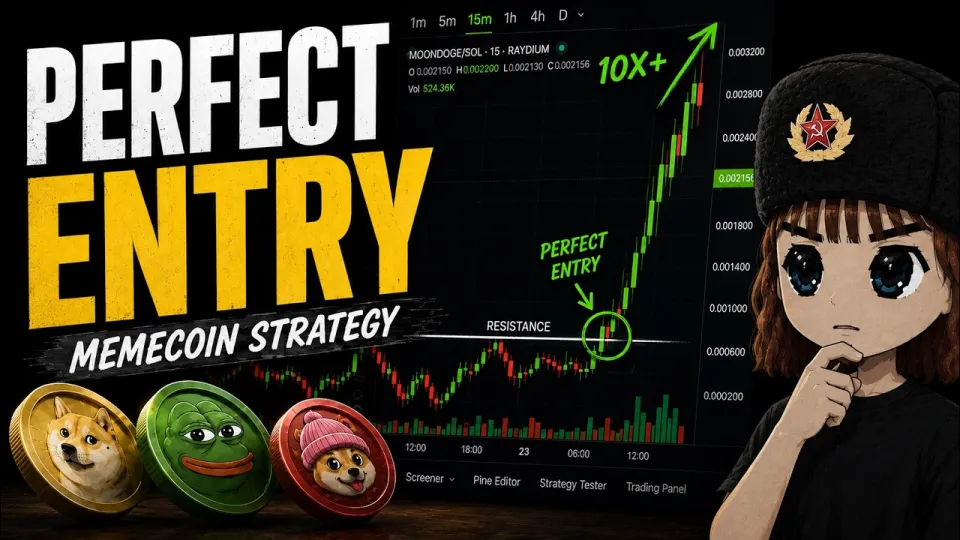
Video: How I Find the PERFECT Entry on Memecoins 📈 (Full Strategy)
Need articles like this for your video? They help promote it on YouTube and Google — order them in the Telegram bot @sat_sit_bot. The bot writes and publishes the articles itself (with your YouTube video embedded) on popular topical websites (no ads). Free trial — 50 articles.
· based on the channel starwifpump
A meme coin is a highly volatile token whose price is driven mainly by attention and liquidity rather than fundamentals, so the quality of your entry matters more than the narrative you bought into. The practical answer is to wait for momentum confirmation, then enter on a pullback into a defined support level with invalidation and position size set in advance. That single rule changes the risk-to-reward of a trade far more than finding a “better” coin ever will. Traders who want the full toolkit the channel uses — paper trading, sniping, copy trading and position tracking in one place — can request early access through the Plasma Telegram channel.
Why entry timing decides the outcome of a meme coin trade
Most meme coin traders do not lose because they picked the wrong coin; they lose because they entered at the wrong moment. A token can double after your stop-out and still have been a bad trade if you bought the top of a vertical candle with no plan. The same token bought on a controlled retest can be a good trade even if it only moves half as far.
The reason is mechanical: on memecoins, liquidity is thin and moves are fast, so the distance between your entry and your invalidation level defines your risk. Enter 40% above support and your stop sits far away; enter on the retest and the same stop is close, which means the same move pays several times more relative to what you risked. Entry quality is therefore a risk-management decision, not a prediction exercise.
The checklist used before any meme coin entry
A repeatable entry process is a short list of conditions that must all be true before capital goes in. The order matters, because each step filters out a different failure mode.
- Liquidity and contract check first. Confirm the pool is deep enough for your size, that the contract is not a fresh mint with suspicious permissions, and that holder distribution is not concentrated in a handful of wallets. No chart pattern compensates for a token you cannot exit.
- Higher-timeframe structure. Look at the chart on a slower timeframe to see whether price is making higher lows or bleeding. Buying strength inside a downtrend is the most common way beginners get trapped.
- Momentum confirmation. You want evidence that buyers are actually in control — expanding volume on up-moves, a break of a prior local high, and follow-through rather than a single wick.
- A defined level to enter against. Identify the support zone, the previous consolidation range, or the breakout level that should now act as a floor.
- Invalidation. Decide the exact price at which the idea is wrong, before you click buy.
- Size and exits. Position size derived from that invalidation distance, plus pre-planned partial profit levels.
How to enter on a pullback instead of chasing the pump
Chasing means buying a candle that is already vertical, where your entry is the high and every seller above you is in profit. The alternative is to let the first impulse happen without you and buy the retest.
What a healthy pullback looks like:
- Price pulls back on declining volume compared with the impulse that preceded it.
- The retracement holds a recognizable level — a prior breakout zone, a range high, or a moving average the trend has respected.
- Buyers step in with a renewed volume spike and the candle closes back above the level rather than wicking through it.
- The pullback is shallow relative to the impulse; a retracement that gives back the entire move is a failed breakout, not a discount.
A useful habit is to define your entry zone as a band, not a single price, and to accept that you will miss some runners. Missing a trade costs nothing; entering at the wrong price costs real capital.
Red flags that mean skip the trade
The most valuable skill in meme coin trading is knowing when not to enter. These signals appear often enough that they are worth memorizing:
- Vertical candles with no consolidation. No base means no reference point for a stop.
- Volume divergence. Price pushes higher while volume fades — the move is being carried by fewer and fewer buyers.
- Repeated failed retests of the same level. Each rejection weakens the level; the third test usually breaks.
- A single wallet holding a large share of supply, or a cluster of fresh wallets funded from the same source.
- Liquidity that is being removed while price holds up.
- A move that only exists on social media. If the chart is flat and the hype is loud, you are the exit liquidity.
Planning risk, exits and profit-taking before the trade
Risk planning happens before entry, not during a drawdown. Three numbers should exist on paper first: entry zone, invalidation price, and the levels where you take profit.
A workable structure is to risk a fixed small percentage of your trading capital per idea, size the position so that the distance from entry to invalidation equals that amount, and take partials into strength — for example scaling out at the first resistance and letting a remainder run with the stop moved to breakeven. Memecoins can round-trip an entire move in minutes, so unrealized gains that are never banked tend to disappear. Equally, do not move your invalidation wider to “give it room”; that is how a planned small loss becomes an account-level loss.
Common questions from newer traders
Beginners tend to ask the same things, and the answers are consistent across chains.
Does this work outside Solana? The mechanics of momentum, pullbacks and invalidation are chart-based and transfer to any chain with enough liquidity. What changes is the tooling and the speed: chains with cheaper, faster execution produce sharper moves and require tighter risk control. Chain choice should follow liquidity, not hype.
How do you find coins before they pump? Screening tools and social trackers help surface candidates, but the entry rules still apply after you find them. A tracker gives you a watchlist; the chart gives you the entry. Treat alerts as the start of analysis, never as a buy signal.
What if I already lost money on memecoins? Reduce size drastically and trade only setups that match the checklist until the process feels boring. If the losses came from chasing, the fix is patience, not a new coin.
How much capital should a beginner use? An amount whose complete loss would not change your financial situation. The goal in the first months is to execute the process correctly, not to compound.
Useful links
- Plasma Telegram — early access, updates and setup help
- Discord community
- Padre terminal VIP access
- Solpump
- starwifpump on X
Bottom line
A meme coin entry is a risk decision disguised as a timing decision: wait for momentum to prove itself, buy the retest into a defined level, and know your invalidation before you commit capital. The checklist in this breakdown — liquidity check, structure, momentum confirmation, pullback entry, invalidation, sizing and exits — is the same framework starwifpump walks through in the full strategy video, and it is designed to be repeated rather than improvised. Skipping trades that fail the checklist is not a missed opportunity; it is the part of the process that protects the account. If you want the tools and community around that process, start with the Plasma Telegram channel for early access and setup help.
Key takeaways
- Most meme coin losses come from bad entry timing, not from picking the wrong token.
- A valid setup needs momentum confirmation plus a pullback into support, not a green candle chase.
- Predefined invalidation and position sizing are set before the trade, not after the drawdown.
- Chasing vertical candles and buying on social hype are the two most common entry mistakes.
- Repeatable process beats prediction: same checklist, same risk, every trade.
Source: How I Find the PERFECT Entry on Memecoins 📈 (Full Strategy) · Markdown version
Questions & answers
What is the best moment to enter a meme coin?
The highest-quality entry is usually a pullback into a defined support or breakout level after momentum has already been confirmed by volume and structure. Buying the vertical candle itself puts your invalidation far away and makes the same move much less profitable relative to the risk taken.
How do I avoid FOMO when a meme coin is pumping?
Decide in advance that you only trade retests, and accept that you will miss some runners. Write down the entry zone, invalidation and size before the move happens, then let the chart come to your level instead of chasing price upward.
Which chart signals tell you not to enter?
Fading volume on higher prices, vertical candles without a base, repeated failed retests of the same resistance, concentrated holder supply, and liquidity being pulled while price holds up. Any one of these is enough reason to skip the trade.
Do the same entry rules apply on every chain?
The chart logic — momentum, pullbacks, support and invalidation — is chain-agnostic. What differs is execution speed and liquidity depth, which affect how tight your risk control needs to be and which tools you use to screen and trade.